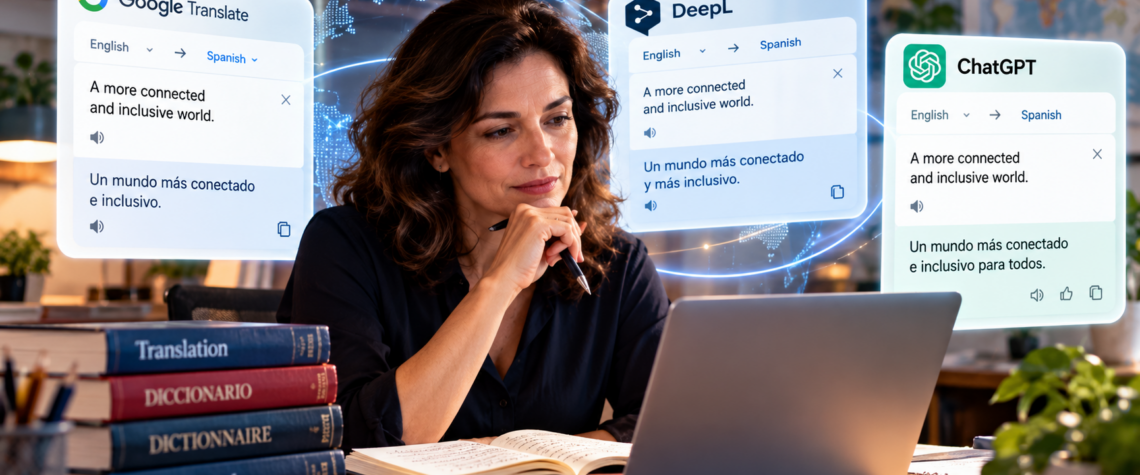
Google Translate, DeepL, and ChatGPT are making communication across languages easier than ever. But when accuracy, cultural understanding, and human judgment matter, how much should we trust the machines?
Imagine arriving in a foreign country without speaking the language. You point your smartphone at a restaurant menu, and the words appear in English. A few minutes later, you speak into the same phone, and it translates your question for a waiter.
What once required a dictionary, a phrasebook, or a bilingual companion now takes seconds.
Artificial intelligence has transformed translation from a specialized service into an everyday convenience. Millions of people use translation tools to understand emails, communicate while traveling, read foreign-language websites, and navigate conversations that would otherwise be impossible.
But the technology is moving beyond simple word-for-word translation. Today’s systems increasingly attempt to understand context, adapt tone, recognize idiomatic expressions, and produce writing that sounds natural in another language.
That progress raises a question with consequences for businesses, professionals, and anyone who depends on accurate communication: Can AI translation tools replace human translators?
The answer depends largely on what needs to be translated—and what might happen if the translation is wrong.
Three Different Approaches to Translation
Among the most recognizable translation tools are Google Translate, DeepL, and ChatGPT. All three use artificial intelligence, but they offer different experiences and are designed around somewhat different needs.
Google Translate: The Everyday Companion
Google Translate remains one of the most practical options for travelers and people who need quick assistance with unfamiliar languages.
Its mobile application can translate text, speech, images, and conversations. Point a phone camera at a sign or menu, and the application can display translated text. Its live translation features can also assist people speaking different languages.
Google has continued incorporating its Gemini AI technology into Translate, including features intended to improve the interpretation of idioms, colloquial expressions, and conversational context.
In September 2026, Google announced improvements to live translation on Android and iOS, including additional ways to listen to translated conversations.
For someone trying to understand a train announcement, read a restaurant menu, or ask for directions, Google Translate offers an exceptionally convenient starting point.
Its limitation is that convenience does not guarantee accuracy. Spoken language, background noise, regional expressions, and ambiguous sentences can still produce misunderstandings.
DeepL: A Focus on Written Language
DeepL has built its reputation around producing natural-sounding written translations and supporting professional document workflows.
The service translates text and documents, including common office file formats. It also offers features such as glossaries, formality settings, and terminology customization, with availability depending on the plan.
These capabilities can be particularly useful for businesses that need consistent terminology across reports, presentations, product descriptions, or customer communications.
For example, a company translating a technical manual may want a particular engineering term rendered the same way throughout hundreds of pages. A customizable glossary can help maintain that consistency.
DeepL also offers tools for translating complete documents while preserving much of their original formatting.
However, a professionally formatted document is not necessarily a professionally verified translation. Specialized terminology, ambiguous language, and industry-specific requirements still need careful review.
ChatGPT: Translation Through Conversation
ChatGPT approaches translation differently.
Instead of simply providing a translated passage, users can explain the intended audience, request a particular tone, ask for alternative expressions, or discuss why a phrase may be difficult to translate.
A user might ask:
“Translate this letter into Spanish for a business audience in Mexico. Keep the tone professional but friendly.”
The user can then request revisions, compare different word choices, or ask the system to explain cultural differences.
This conversational approach is useful for drafting emails, adapting marketing messages, and exploring how meaning changes across languages.
But it also introduces a particular risk.
Because ChatGPT is designed to generate natural language, it may sometimes rewrite, interpret, or expand a passage instead of preserving the original wording precisely.
That flexibility can be valuable for adapting a message. It can be dangerous when a faithful translation is required.
The Difference Between Translating Words and Translating Meaning
Consider the English expression “It’s raining cats and dogs.”
A literal translation into Spanish would be nonsensical in most situations. A human translator would usually choose an equivalent expression such as “Está lloviendo a cántaros” or simply “Está lloviendo muchísimo,” depending on the audience and context.
Modern AI systems can often recognize familiar idioms and provide appropriate alternatives.
But not every translation problem is so straightforward.
Humor, irony, sarcasm, regional slang, political references, and literary language can depend on shared cultural knowledge.
A phrase that sounds affectionate in one country may sound disrespectful in another. A technically correct translation may be too formal for a conversation or too casual for a business letter.
Even apparently simple words can create problems.
The Spanish word “embarazada” means “pregnant,” not “embarrassed.” The English word “actual” generally means “real,” while the Spanish “actual” usually means “current.”
Translation tools have become better at handling these familiar traps. More difficult are situations in which the correct meaning depends on information that is not explicitly stated.
Human translators can ask questions, investigate cultural references, consult specialists, and make informed editorial decisions.
An AI system may instead produce a confident answer without recognizing that the original text is ambiguous.
When AI Translation Works Well
For many everyday tasks, AI translation can be extraordinarily useful.
A traveler may need to understand a sign. A student may want to read an article in another language. A small business owner may need a preliminary translation of a supplier’s email.
In these situations, the goal is often comprehension rather than publication-quality precision.
AI translation can save time and reduce language barriers. It can also help bilingual users draft messages more quickly or check unfamiliar vocabulary.
For routine, low-risk communication, an automated translation may be entirely sufficient.
The important question is not whether the translation is perfect, but whether it is accurate enough for its intended purpose.
Understanding the general meaning of a restaurant review requires a different standard from translating a medical diagnosis.
When a Mistake Can Have Serious Consequences
There are situations in which an apparently minor translation error can change someone’s life.
A medical instruction may contain a dosage, a warning, or a description of symptoms. A legal document may establish obligations, deadlines, or rights. An immigration application may require precise terminology.
In these settings, a translation that sounds natural can still be dangerously misleading.
A single omitted word, incorrect number, or misunderstood negative statement can alter the meaning of an entire passage.
Medical and legal translation often requires specialized knowledge beyond fluency in two languages.
Professional translators and interpreters may also be required to follow confidentiality standards, certification rules, or institutional procedures.
AI can assist with preparation or preliminary drafts, but it should not be the sole authority for high-stakes communication.
This concern is not merely theoretical. Cochrane, the international organization known for systematic reviews of medical research, cautions that AI translation tools can be useful for understanding material but may misinterpret technical terminology and context when research accuracy is essential.
Can AI Translate Literature?
Literary translation presents a different challenge.
A novel is not simply a collection of sentences that communicate information. Its language carries rhythm, ambiguity, atmosphere, humor, and the distinctive voice of its author.
Consider a passage by William Faulkner, whose prose often moves through long, intricate sentences, shifting perspectives, and unconventional relationships between time and memory.
A machine might reproduce the literal meaning of the words while losing the musicality, tension, or deliberate uncertainty of the original.
A human literary translator must decide not only what a sentence means but how it should feel to a reader in another language.
Sometimes preserving the author’s voice requires departing from the most literal translation.
AI may provide a useful first draft or suggest alternatives. Whether it can consistently reproduce the artistic intentions of a complex literary work is another matter.
For literature, translation remains as much an act of interpretation as an exercise in linguistic accuracy.
The Privacy Question Most Users Overlook
There is another important issue when using online translation services: what happens to the information submitted?
People routinely paste emails, contracts, business proposals, medical documents, and personal messages into translation applications.
Depending on the service, account settings, subscription, and applicable privacy policies, that content may be processed, retained, or used in ways the user does not fully understand.
Some business-oriented translation plans offer stronger confidentiality commitments and controls than consumer services.
Before translating sensitive material, users should examine the provider’s privacy terms and avoid uploading confidential documents unless they are authorized to do so.
A convenient translation tool should not become an unintended channel for exposing private information.
Which Translation Tool Should You Choose?
No single application is the best choice for every situation.
| Your need | A practical starting point |
|---|---|
| Travel, signs, menus, and spoken conversations | Google Translate |
| Business documents and consistent terminology | DeepL |
| Drafting, adapting tone, and discussing word choices | ChatGPT |
| Legal, medical, or certified documents | Qualified human translator |
| Literary translation and culturally sensitive writing | Human translator, potentially assisted by AI |
These recommendations reflect the tools’ published capabilities and typical use cases, not the results of a controlled, hands-on accuracy test. Actual performance varies by language pair, subject matter, and the complexity of the text.
Users should also compare free-plan limitations, paid features, and privacy policies before choosing a service.
Five Ways to Get Better AI Translations
AI translation works best when users understand its limitations and provide enough context.
First, explain the purpose of the translation. A casual message to a friend should not sound like a legal notice.
Second, identify the intended audience. Spanish used in Mexico, Argentina, and Spain shares a common language but includes meaningful differences in vocabulary and expression.
Third, ask the system to identify ambiguous phrases rather than silently guessing their meaning.
Fourth, compare important passages with another translation method or have a bilingual person review them.
Finally, never rely exclusively on an automated translation when the consequences of an error could be serious.
These precautions take little time but can make a substantial difference in the reliability of the result.
Our Verdict: A Powerful Assistant, Not a Universal Replacement
AI translation has become one of the most useful applications of artificial intelligence.
Google Translate makes everyday multilingual communication more accessible. DeepL offers valuable capabilities for translating documents and managing terminology. ChatGPT provides a flexible conversational approach that helps users explore tone, context, and alternative expressions.
Each has strengths, and each has limitations.
For routine communication, these tools can reduce the need for human assistance. For professional translation, they can improve productivity and support the work of experienced translators.
But when accuracy, cultural sensitivity, legal responsibility, or artistic expression is essential, human expertise remains valuable.
The future of translation may not be a contest between people and machines. It may be a collaboration in which AI handles repetitive work while human professionals concentrate on meaning, judgment, and quality.
Technology can translate words in seconds.
Understanding exactly what another person means—and what those words should mean to someone else—remains a more demanding task.
Sources and further reading
- Google Translate Help Center — Translation features and supported workflows.
- Google Blog — Google Translate’s Gemini-powered translation improvements, 2025–2026.
- DeepL Help Center — Translator features, document translation, and glossaries.
- OpenAI Help Center — ChatGPT language support.
- Cochrane — Guidance on the limitations of machine translation in research.